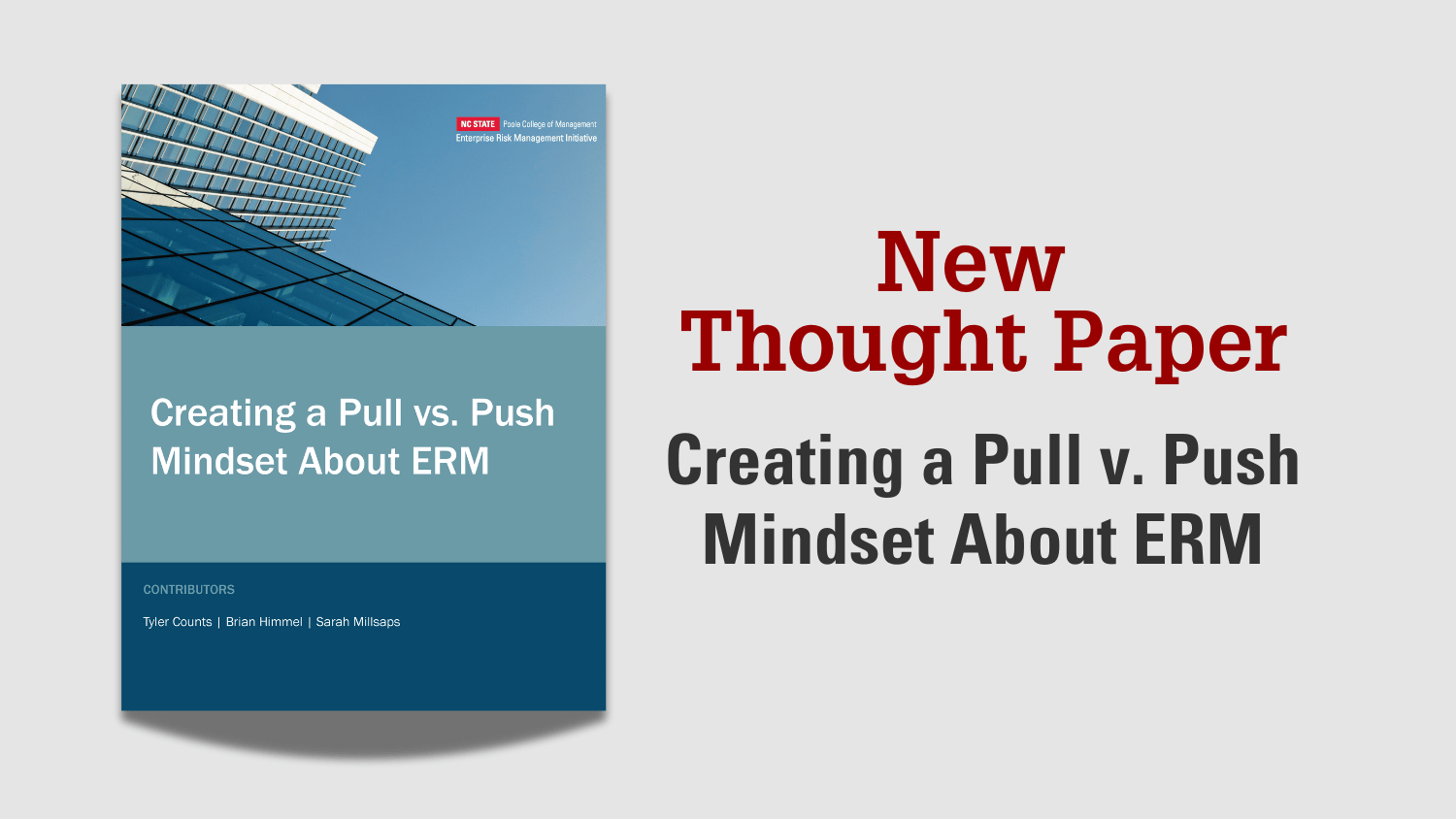
Creating a Pull vs. Push Mindset About ERM
A New Way to Assess ERM Impact: Push vs. Pull Mindset
Many organizations have matured their enterprise risk management (ERM) processes, but are they delivering real strategic value?
A new thought paper from Poole College of Management graduate students, working with the NC State ERM Initiative, Creating a Pull vs. Push Mindset About ERM, challenges risk leaders to move beyond checklists and frameworks and instead focus on building a “pull” mindset — where executives seek out ERM insights because they find them essential to decision-making and strategy.
Why This Matters: Maturity ≠ Value
ERM maturity is often used as a proxy for effectiveness, but mature programs can still fall short in impact. According to the paper, a key shift occurs when organizations stop asking, “How mature is our ERM program?” and start asking, “How much value are we creating?”
What’s a “Pull” Mindset in ERM?
Borrowing from supply chain and marketing concepts, this paper applies the pull vs. push framework to risk management:
- Pull ERM – Executives and board members request risk insights because they see clear value.
- Push ERM = Risk teams deliver information to executives in hopes of engagement.

Organizations that operate with a pull mindset experience stronger integration between ERM and strategy. A pull mindset is present when executives use ERM outputs in board agendas, capital allocation decisions, and strategic planning retreats.
Signs You Have a Pull Strategy
The paper outlines several indicators of a “pull” ERM environment:
- Executives proactively request emerging risk insights
- ERM outputs are used to guide board oversight and strategy sessions
- Business units seek out ERM input for new initiatives
- Risk dashboards are tailored and valued—not just archived
Five Action Steps to Shift Your ERM Culture
If your ERM program feels like “pushing a boulder uphill,” this paper outlines five practical steps to create greater traction and strategic relevance:
- Map Risks to Strategy – Are your top risks connected to what drives enterprise value?
- Conduct an Honest Self-Assessment – Are you surfacing the unknowns?
- Challenge Where Attention Is Given – Are you prioritizing insight over logistics?
- Seek User Feedback – How do your stakeholders really perceive ERM?
- Focus on Insight, Not Just Information – Are you highlighting patterns and dependencies?
Who Should Read This
This resource is ideal for:
- Organizations looking to evolve ERM from a compliance function to a strategic asset
- Chief Risk Officers (CROs) and ERM program leaders
- Strategic planning and performance management teams
- Board members and executive leadership seeking actionable risk intelligence
About the Authors
This thought paper was developed by Tyler Counts, Brian Himmel, and Sarah Millsaps, former graduate students in the Poole College of Management at NC State University. Under the guidance of faculty advisor Ericka Kranitz, the team conducted in-depth interviews with 39 ERM leaders across industries. Their research captures real-world insights on how to evolve ERM into a strategic function that informs executive decision-making and drives organizational value.
Original Article Source: “Creating a Pull vs. Push Mindset,” Tyler Counts, Brian Himmel, and Sarah Millsaps, NC State University Poole College of Management, January 2026.